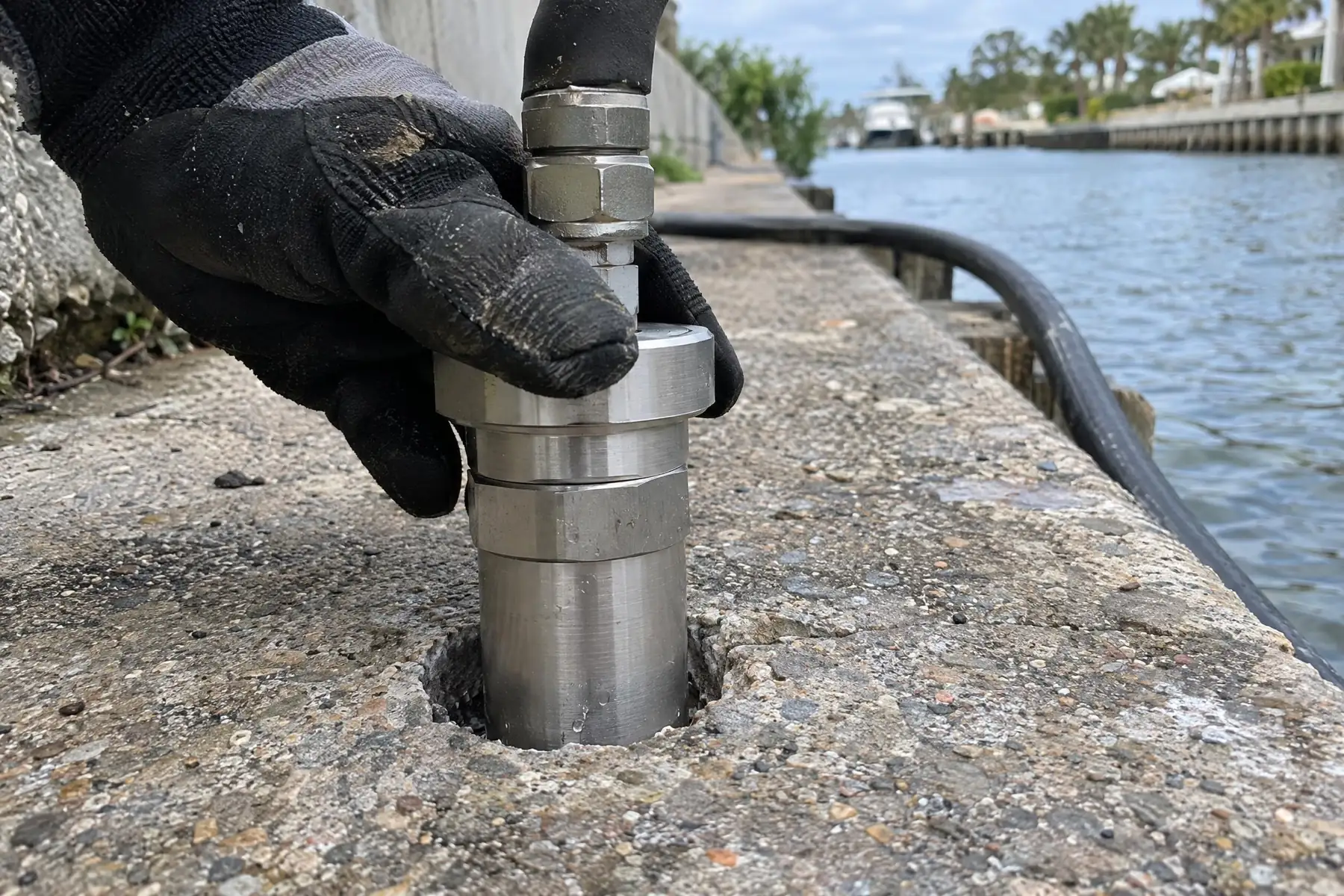
A gloved hand holding a steel injection port in a drilled hole in a concrete walkway beside a canal

Polyjacking vs Mudjacking in Fort Lauderdale, FL: Foam vs Mudjacking and Mudjacking vs Polyurethane Foam

Polyjacking vs Mudjacking in Fort Lauderdale, FL: Which Lift Fits Your Slab

Two quotes for the same sunken slab can name different methods, and Fort Lauderdale Concrete Repair & Leveling explains the choice for Fort Lauderdale, FL and Broward County. This page weighs polyjacking vs mudjacking, along with mudjacking vs polyurethane foam and the foam vs mudjacking question, for a driveway, a pool deck, a walkway or a patio. Each method lifts by filling the space beneath the concrete, and each differs in material, cure time, price and staying power in wet sand.

Why homeowners choose us:

  • Free written estimates for every leveling job
  • Small injection holes patched and cleaned up after every lift
  • Water-resistant foam that does not wash out
  • Warrantied work every lift backed by a written warranty
  • Licensed and insured certificate on request

The crew has 15+ years in South Florida and 900+ slabs lifted. The estimate lists a method per slab, so you can compare them on your own concrete. Every lift also comes with a no-charge written quote and a warranty in writing. Plan on 2 to 6 hours for most jobs, depending on slab size and void depth.

Get a FREE Concrete Leveling Quote

Polyjacking vs Mudjacking: How Each Lifts a Fort Lauderdale Slab

Polyjacking sends liquid polyurethane foam through penny-size holes, under pressure. The foam swells, firms the soil and raises the slab, with gauges signaling when the base is solid. Mudjacking also bores holes, but it pumps a cement-based slurry. Slab jacking vs foam, then, is a question of what gets pumped beneath the concrete.

Slurry lifts by weight and volume, whereas foam lifts by expansion. A small shot of foam multiplies in volume and wedges into the narrowest gaps. Because foam weighs less, it puts almost no extra weight on soft ground. Mudjacking needs bigger holes, and the slurry must set before the slab reaches full strength. Either approach demands a watchful crew, since lifting too far cracks the concrete. A level and the gauges steer the work, and the crew stops once the surface matches the slab beside it.

Both methods suit an intact slab, so the decision rests on two things: the ground beneath it and how quickly you need to use it again. Neither replaces a careful estimate.

Appearance and cleanup differ as well. Foam holes are small and vanish under a sanded patch, while slurry holes are wider and leave a larger round mark. Neither method is messy in the hands of a careful crew, but slurry needs more room for hoses and a mixing truck, so a tight side yard can tip the choice. The sections that follow give numbers for each, and the final one maps them onto your own surface.

Polyjacking vs Mudjacking: Cure Time and Cost in Fort Lauderdale

Foam hardens in 30 to 60 minutes, while mudjacking needs one to three days to dry. Foam lands 20 to 50 percent above mudjacking or stone slurry grout. This table sets the two side by side:

FactorPolyurethane foamMudjacking
MaterialExpanding polyurethane foamCement-based slurry
Hole sizeAbout the width of a pennyWider than foam holes
Cure time30 to 60 minutesOne to three days to dry
Walk on it15 to 30 minutesAfter the slurry sets
CostAbout 20 to 50 percent moreLower, and stone slurry runs $750 to $1,500
How long it lasts5 to 10 years or more5 to 10 years

The premium buys speed and a lighter footprint on the lawn, along with a slab back in service the same day. Foam holes are penny-sized and slurry holes are wider, so patches from a mudjacking job show more. Mudjacking suits work where budget outweighs waiting, and a back walkway nobody needs this week is a fair example. The cost page lists foam ranges by surface, and your estimate shows the gap for your own slab.

Cure time matters more than it looks on paper. A driveway that cannot be used for three days forces cars onto the street, and a pool deck that stays closed disrupts a household for the same stretch. Foam shortens that window to the length of the visit, which is why owners with tight schedules accept the premium.

Polyjacking vs Mudjacking on the Sandy Ground Under Fort Lauderdale Slabs

Fort Lauderdale rests on fine sand, and in the wettest months groundwater reaches 0 inches in Basinger and Boca fine sand. Loose sand compacts badly, so the base under a slab starts out soft. Slurry adds heavy weight to that base, and it can also wash away whenever groundwater shifts through the sand once more.

Foam is water-resistant, and it stays where it is placed. Where the ground sits wet for months, that property decides how long a lift lasts. As it expands it also packs the loose sand, which addresses the reason the slab dropped. The Fort Lauderdale-Hollywood station records roughly 56 inches of rainfall annually, with nearly 70 percent arriving from mid-May to mid-October. Which is better, mudjacking or foam, hangs on the slab, but in wet sand water resistance carries real weight. Rainy months raise the stakes, because a lift finished in June meets the heaviest rainfall of the year within weeks, so the fill must tolerate water from the start.

Mudjacking still earns a place on a Fort Lauderdale property. Slurry works best on a wide, uniform void where the pump has open access, and there the bill stays low. The estimate says which method fits and does not push the pricier one when the cheaper one will hold. A seller closing soon or an owner with a rarely used back walk may sensibly choose slurry and keep the difference. Anyone with a pool deck or a daily driveway gets more from foam. Condo boards and property managers lean toward foam on walkways, because closing a path for two or three days costs more trouble than the price gap.

Polyjacking vs Mudjacking for a Fort Lauderdale Driveway, Pool Deck or Sidewalk

The right method follows the slab, the void under it and your timeline. Here is how the call tends to land on the surfaces we lift most:

  • A driveway favors foam when the car must return to the garage that day, while slurry makes sense for a wide, uniform void.
  • A pool deck favors foam, since big voids and wet ground reward a water-resistant fill.
  • A sidewalk works with either method, and the run length plus the budget settle it.
  • Soft, wet ground under any slab points to foam, which packs the soil as it fills.

Each slab on the estimate carries a named method and a separate price, so every choice shows its cost. Fragmented concrete may be better replaced, and the site visit settles that question. If a quote you hold names only one method, ask the contractor to explain, because two slabs on one property can call for different methods.

Polyjacking vs Mudjacking FAQs: Fort Lauderdale, FL

Which is better, mudjacking or foam?

Foam hardens faster, needs smaller holes and resists water, while mudjacking costs less. In wet Fort Lauderdale sand foam fits most slabs. Mudjacking earns its place on a roomy, even void when money is tight.

Is polyjacking vs mudjacking a price decision?

Partly, because foam costs 20 to 50 percent more. That premium buys a slab usable within minutes, smaller holes and a fill that stays put.

What is the difference between foam and mudjacking?

Mudjacking relies on a cement-based slurry, and foam jacking relies on expanding polyurethane delivered under high pressure. That choice of material sets hole size, cure time and wet-ground behavior.

How long does each method last?

Mudjacking holds for a span of 5 to 10 years, while foam is expected to match that or exceed it. Ground conditions, rainfall and the load above all shape the result.

Can slab jacking vs foam be mixed on one property?

Yes, a driveway can take one method and a pool deck the other, since the estimate names a method for each slab. Every slab gets its own priced line.

Does either method fix cracks?

Neither repairs a crack, though bringing a slab back to level can stop a crack from getting worse. Concrete broken into small pieces may need replacing.

Does the work come with a warranty?

A written warranty comes with every job, and its terms appear in your estimate before work starts. Ask the office to walk you through it when you call.

Fort Lauderdale Concrete Repair & Leveling serves Fort Lauderdale and Broward County.

Get a Free Concrete Leveling Quote in Fort Lauderdale, FL

(954) 738-4852 Get a Free Quote